What is cultural competence? This exploration delves into the multifaceted nature of understanding and interacting effectively with diverse cultures. We’ll navigate the key components, from defining the term itself to examining its application in various settings, including healthcare, education, and customer service. This journey promises to enlighten us on the significance of cultural competence in fostering inclusivity and respect in our interconnected world.
This guide will equip you with the knowledge and tools to navigate the complexities of cultural differences. We’ll uncover the dimensions of cultural competence, from individual awareness to systemic factors, and explore the steps to develop this crucial skill. Through real-world examples and case studies, we’ll see how cultural competence fosters understanding, respect, and effective communication. Let’s embark on this enlightening exploration together.
Defining Cultural Competence

Embarking on the journey of cultural competence is not merely about acquiring knowledge; it’s about cultivating a mindset and a set of skills that allow us to interact effectively and respectfully with people from diverse backgrounds. It’s about moving beyond simple awareness to a deeper understanding and appreciation of cultural differences. This journey requires a commitment to ongoing learning and reflection, recognizing that our own biases and assumptions can significantly influence our interactions.Cultural competence is not a destination but a continuous process of growth and development.
It involves recognizing the inherent value in every culture and working to build bridges of understanding between people from different backgrounds. By actively seeking out opportunities to learn from others, we can cultivate a more inclusive and equitable society for all.
Defining Cultural Competence
Cultural competence is the ability to understand, appreciate, and interact effectively with people from diverse cultural backgrounds. It’s not simply about knowing facts about different cultures, but about developing the skills to navigate intercultural interactions with sensitivity and respect. It requires an understanding of one’s own cultural biases and assumptions, and the ability to adapt communication styles to ensure effective and respectful dialogue.
Key Components of Cultural Competence
Several key components contribute to cultural competence. These include self-awareness of one’s own cultural background and biases, knowledge and understanding of diverse cultures, and the ability to adapt communication styles to different cultural contexts. Critical thinking and the ability to view situations from various perspectives are crucial. Finally, the capacity to build relationships and foster trust with individuals from diverse backgrounds is essential.
Difference Between Cultural Awareness and Cultural Competence
Cultural awareness is the first step on the path to cultural competence. It involves recognizing that cultural differences exist and understanding the impact of these differences on communication and behavior. Cultural competence, however, builds on this awareness by equipping individuals with the skills and knowledge to interact effectively and respectfully across cultures. Cultural awareness provides the foundation, while cultural competence enables the practical application of that knowledge.
Models of Cultural Competence
Numerous models have been developed to guide individuals and organizations in developing cultural competence. These models offer frameworks for understanding the various stages and dimensions of cultural competence, enabling a structured approach to intercultural interactions. Each model emphasizes different aspects, but they all aim to provide a roadmap for cultural growth.
Comparison of Cultural Competence Models
| Model Name | Key Concepts | Target Audience | Application Examples |
|---|---|---|---|
| Bennett’s Developmental Model of Intercultural Sensitivity | Stages of intercultural sensitivity, from denial to integration. | Individuals and groups seeking to improve intercultural interactions. | Training programs for employees working with diverse clients, development of intercultural communication skills. |
| Sue’s Model of Cultural Competence | Focuses on the process of cultural competence within a counseling context. Includes awareness, knowledge, skills, and encounters. | Mental health professionals, educators, and social workers. | Developing culturally sensitive assessment and intervention strategies, creating culturally inclusive counseling settings. |
| Cross, Bazron, Dennis, & Isaacs’s Model of Cultural Competence | Focuses on organizations and their capacity to effectively serve diverse populations. | Organizations and institutions seeking to improve their service delivery. | Creating culturally responsive policies and procedures, hiring diverse staff, conducting cultural assessments. |
| Purnell Model for Cultural Competence | Provides a comprehensive framework for understanding and appreciating diverse cultures. | Healthcare providers, educators, and community workers. | Developing culturally sensitive healthcare practices, creating culturally inclusive educational environments, building strong community relationships. |
Dimensions of Cultural Competence

Embarking on the journey of cultural competence is not a simple checklist; it’s a multifaceted exploration. Understanding the intricate tapestry of human experience requires acknowledging the diverse dimensions that contribute to our individual and collective identities. These dimensions aren’t isolated entities; rather, they intertwine and influence one another, creating a rich and complex interplay. Let’s delve into these essential components.
Knowledge and Awareness
A cornerstone of cultural competence is a deep understanding of one’s own cultural background and the backgrounds of others. This involves recognizing the influence of cultural values, beliefs, and practices on individual behavior and societal norms. Acknowledging the inherent biases and stereotypes that can unconsciously shape perceptions is paramount. Cultural humility, a continuous process of self-reflection and learning, is crucial for navigating this intricate landscape.
Skills and Attitudes
Cultural competence is not just about knowing; it’s about doing. Essential skills include active listening, empathy, and the ability to communicate effectively across cultures. Open-mindedness, respect, and a willingness to learn from diverse perspectives are crucial attitudes. These skills and attitudes allow individuals to approach interactions with others from a position of understanding and respect, fostering trust and mutual understanding.
Application in Practice
Imagine a healthcare professional interacting with a patient from a different cultural background. The practitioner demonstrates cultural competence by actively listening to the patient’s concerns, acknowledging their cultural beliefs, and adapting their communication style to ensure effective understanding. This illustrates the practical application of knowledge and skills to create a positive and supportive environment. This interaction showcases the importance of adapting communication styles and showing genuine respect for cultural nuances.
Interrelation of Dimensions
The dimensions of cultural competence are not isolated entities; they are interconnected and interdependent. Knowledge about cultural differences fuels the development of skills and attitudes. These skills and attitudes, in turn, lead to effective application in real-world situations. For example, a deep understanding of cultural norms surrounding communication (knowledge) informs the development of effective communication strategies (skills) and fosters an empathetic attitude (attitude) when interacting with people from diverse backgrounds.
Framework of Interrelation
 (A visual representation, not provided here, could depict a cyclical diagram illustrating the interconnectedness of knowledge, skills, attitudes, and application in practice.) This diagram, while absent here, would depict how each dimension influences and supports the others in a continuous loop. The continuous feedback loop emphasizes the ongoing nature of cultural competence development.
Understanding cultural competence involves recognizing and appreciating the diverse perspectives and experiences within a community. It’s about fostering an environment where different viewpoints are not only tolerated but valued. This contrasts with the often contentious and sometimes polarizing phenomenon of “cancel culture,” a complex social phenomenon where individuals or groups are criticized or ostracized for perceived transgressions. Learning more about this can help us better appreciate the nuances of cultural interactions and how to navigate them with respect and understanding.
Ultimately, cultural competence is about building bridges and fostering a more inclusive and harmonious society. what is cancel culture By acknowledging both the positive and challenging aspects of social interactions, we can work towards a more inclusive and respectful approach.
Dimensions of Cultural Competence Table
| Dimension | Description | Practical Skill Example | Application Scenario |
|---|---|---|---|
| Knowledge | Understanding of cultural values, beliefs, and practices. | Researching cultural customs and traditions. | Preparing for an international business meeting. |
| Skills | Ability to communicate effectively across cultures. | Using nonverbal cues to enhance communication. | Leading a diverse team. |
| Attitudes | Open-mindedness, respect, and a willingness to learn. | Asking clarifying questions to gain a deeper understanding. | Interacting with individuals from different cultural backgrounds. |
| Application | Implementing knowledge, skills, and attitudes in real-world situations. | Adapting communication styles to meet the needs of others. | Providing culturally sensitive care to patients. |
Developing Cultural Competence
Embarking on the journey of cultural competence is not a destination but a continuous process of growth and learning. It’s about recognizing the profound impact of culture on individuals and interactions, and actively working to understand and appreciate those differences. This involves a willingness to step outside your comfort zone, embrace diverse perspectives, and actively seek opportunities for personal and professional development.Developing cultural competence is a multifaceted process, requiring self-awareness, intentional learning, and consistent effort.
It’s not about achieving perfection, but about continually striving to understand and interact effectively with people from different backgrounds. This commitment to growth and learning is crucial for fostering meaningful connections and building a more inclusive world.
The Process of Development
The development of cultural competence is not a linear progression. It’s a dynamic and iterative process that involves moving through various stages of understanding and application. Each interaction and experience serves as a learning opportunity, refining your knowledge and skills. A key element is recognizing the importance of ongoing self-assessment and reflection. This allows you to identify areas where further growth is needed and adjust your approach accordingly.
Self-Reflection: The Cornerstone of Growth, What is cultural competence
Self-reflection is paramount in developing cultural competence. It’s not just about acknowledging your own biases and assumptions; it’s about actively questioning them and seeking to understand their roots. This involves honestly examining your own cultural background and its impact on your worldview. By understanding your own cultural filters, you can better appreciate how they shape your interactions with others.
This introspection allows for more nuanced and effective communication across diverse groups. It’s a vital tool for challenging preconceived notions and fostering genuine empathy.
Strategies for Continuous Learning
Cultivating cultural competence requires ongoing engagement with diverse perspectives. This includes seeking out opportunities to interact with people from different backgrounds, actively listening to their stories, and engaging in meaningful conversations. Attend workshops, conferences, and seminars focusing on cultural sensitivity. Read books and articles by authors from various cultural backgrounds. Engage in cultural exchange programs or volunteer activities that expose you to different ways of life.
These active steps will deepen your understanding and provide invaluable insights.
Resources for Cultivating Cultural Competence
Numerous resources are available to support your journey towards cultural competence. Organizations dedicated to diversity and inclusion offer workshops, training programs, and online resources. Libraries and bookstores provide access to a wide range of books and articles on cultural topics. Online platforms and social media groups can connect you with diverse communities and facilitate learning. These resources, when utilized strategically, can provide a wealth of knowledge and practical tools.
Methods for Assessing Cultural Competence
Assessing your own cultural competence involves self-evaluation and honest reflection. Here are some methods:
- Identify your own cultural biases and assumptions. This is the first step to challenging your preconceptions and seeking a more accurate understanding of others.
- Reflect on your past interactions with people from diverse backgrounds. What were the outcomes? What could you have done differently? Recognizing past experiences can help you to identify areas for improvement.
- Evaluate your communication style and its potential impact on others. Are you adapting your communication to different cultural contexts? Are you truly listening and understanding diverse perspectives?
- Seek feedback from colleagues, mentors, and people from different cultural backgrounds. Constructive criticism can provide valuable insights into your approach and areas where you can enhance your skills.
- Consider your emotional responses to diverse situations. Are you comfortable with ambiguity? Are you open to new experiences? Emotional responses are an indicator of your level of comfort and adaptability.
Applications of Cultural Competence
Embracing cultural competence isn’t just a theoretical exercise; it’s a practical toolkit for navigating the complexities of our increasingly interconnected world. It empowers individuals and organizations to build bridges across diverse backgrounds, fostering understanding and respect. This translates to improved communication, stronger relationships, and more effective outcomes in various settings.Cultural competence is crucial for success in today’s diverse world.
By recognizing and appreciating the unique perspectives and experiences of others, we can foster environments where everyone feels valued and respected. This, in turn, leads to better collaboration, stronger communities, and more impactful solutions.
Cultural Competence in Healthcare
Effective healthcare relies heavily on understanding patients’ cultural backgrounds. Medical professionals need to consider cultural factors influencing health beliefs, treatment preferences, and communication styles. For example, some cultures may prioritize holistic approaches to healing, including traditional remedies alongside modern medicine. Similarly, communication styles vary widely; some cultures prefer direct communication, while others may value indirectness. Cultural competence in healthcare ensures that patients receive the appropriate care tailored to their unique needs and preferences.
Cultural Competence in Education
In education, cultural competence is essential for creating inclusive learning environments. Teachers must recognize and address the diverse learning styles, values, and backgrounds of their students. This includes understanding the impact of cultural differences on student motivation, participation, and academic performance. Educators can adapt their teaching methods and materials to cater to diverse learning needs, creating a more enriching and equitable learning experience for all students.
For example, incorporating diverse perspectives into curriculum materials helps students understand the world from various viewpoints, fostering empathy and critical thinking.
Cultural Competence in Customer Service
In the realm of customer service, cultural competence translates to providing exceptional service to individuals from all backgrounds. Understanding cultural nuances in communication styles, customs, and expectations is key to building rapport and fostering trust. For instance, some cultures may prefer a formal approach in interactions, while others may favor a more casual tone. A culturally competent customer service representative demonstrates empathy, patience, and an ability to adapt their communication style to meet the specific needs of each customer.
This, in turn, leads to higher customer satisfaction and loyalty.
Cultural Competence and Intercultural Communication
Cultural competence significantly enhances communication in intercultural interactions. By understanding and appreciating diverse communication styles, we can avoid misinterpretations and misunderstandings. For example, nonverbal cues can carry different meanings across cultures, leading to misinterpretations. A culturally competent approach recognizes the importance of active listening, clear communication, and seeking clarification when needed. It encourages open dialogue and a willingness to learn from others, ultimately fostering stronger connections and deeper understanding.
Table: Examples of Cultural Competence Applications Across Sectors
| Sector | Scenario | Challenges | Solutions |
|---|---|---|---|
| Healthcare | A patient from a culture that values family involvement in medical decisions. | Difficulties in communicating treatment options to the patient without the family’s participation. | Involving family members in discussions, using interpreters, and providing culturally sensitive information. |
| Education | A student from a culture with a different approach to learning. | Challenges in adapting teaching methods to accommodate diverse learning styles. | Using a variety of teaching methods, incorporating diverse perspectives into curriculum, and fostering a classroom environment that values different learning styles. |
| Customer Service | A customer from a culture with a preference for formal communication. | Difficulties in adapting communication style to meet the customer’s expectations. | Using respectful language, maintaining a professional demeanor, and showing patience in understanding the customer’s needs. |
| Business | Negotiating a deal with a partner from a culture with different business customs. | Misunderstandings due to differing communication styles and expectations. | Conducting thorough research on the partner’s culture, using a mediator when needed, and adapting communication style to the partner’s preferences. |
Challenges and Barriers to Cultural Competence

Embarking on the journey toward cultural competence isn’t always a smooth path. Navigating diverse perspectives and experiences requires acknowledging the obstacles that can impede progress. These obstacles range from deeply ingrained biases to systemic inequities, creating a complex landscape for individuals and organizations striving for inclusivity. Understanding these challenges is crucial for developing effective strategies to overcome them.
Common Challenges in Achieving Cultural Competence
Cultural competence isn’t a destination but an ongoing process. Individuals and institutions often encounter hurdles that impede their progress. These challenges stem from various factors, including limited exposure to diverse cultures, lack of awareness of one’s own biases, and insufficient resources for cultural learning. Recognizing these common challenges is the first step towards creating a more inclusive environment.
Potential Biases and Stereotypes
Unconscious biases and stereotypes are deeply rooted in societal norms and can significantly hinder cultural competence. These biases, often manifesting as assumptions about individuals based on their cultural background, can lead to misinterpretations, prejudice, and discrimination. Addressing these biases is critical for creating a just and equitable society. Challenging preconceived notions and actively seeking to understand different cultural perspectives is essential.
Systemic Barriers
Systemic barriers, deeply ingrained in societal structures and institutions, create significant obstacles to achieving cultural competence. These barriers can manifest in various forms, such as discriminatory policies, unequal access to resources, and lack of representation in leadership positions. Overcoming these systemic barriers requires a multifaceted approach that addresses the root causes of inequality. Examples include policies that disadvantage certain groups based on race or ethnicity, lack of access to quality education for marginalized communities, and limited opportunities for economic advancement.
Cultural Humility as a Mitigation Strategy
Cultural humility, a concept contrasting with cultural competence, acknowledges the limitations of one’s own knowledge and experience in understanding other cultures. It promotes a continuous learning process, recognizing that true understanding requires ongoing self-reflection and a commitment to lifelong learning. Adopting a culturally humble approach involves recognizing that one’s own cultural background shapes their perspectives, actively seeking feedback from individuals from different cultures, and embracing the possibility of continuous growth.
Strategies for Overcoming Barriers to Cultural Competence
Developing strategies to overcome barriers to cultural competence is crucial for creating a more inclusive and equitable society. Strategies include increasing cultural awareness, promoting cross-cultural communication, and actively challenging stereotypes. Engaging in self-reflection, seeking diverse perspectives, and developing culturally sensitive communication skills are all essential steps in this process. Active listening and building genuine relationships are also critical elements of fostering cultural competence.
Impact of Barriers on Cultural Competence
| Barrier Type | Description | Impact on Individuals | Strategies to Overcome |
|---|---|---|---|
| Unconscious Bias | Preconceived notions and assumptions about individuals based on their cultural background. | Can lead to misinterpretations, prejudice, and discrimination. Can negatively impact relationships and interactions. | Engage in self-reflection, seek feedback from diverse individuals, actively challenge stereotypes, and participate in cultural sensitivity training. |
| Systemic Inequality | Discriminatory policies, unequal access to resources, and lack of representation in leadership positions. | Creates disparities in opportunities and outcomes for different cultural groups. Can perpetuate cycles of disadvantage. | Advocate for policy changes, promote diversity and inclusion initiatives, and support organizations working to address systemic inequalities. |
| Lack of Cultural Awareness | Limited exposure to and understanding of diverse cultures. | Can lead to misunderstandings, misinterpretations, and insensitive behaviors. | Seek out diverse experiences, engage in cultural exchange programs, and actively learn about different cultures. |
| Language Barriers | Difficulties in communication due to differences in language. | Can hinder effective communication and create misunderstandings. May lead to exclusion from social and professional interactions. | Provide language support, utilize interpreters or translation services, and learn basic phrases in relevant languages. |
Cultural Competence in Action
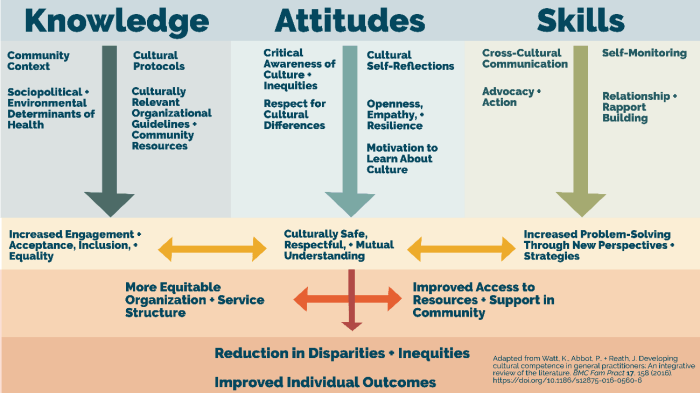
Embarking on a journey of cultural competence is not merely about acquiring knowledge; it’s about weaving that knowledge into the fabric of our interactions. It’s about seeing the world through diverse lenses and recognizing the richness that each perspective brings. This practical application of cultural competence transforms fleeting awareness into tangible actions that build bridges and foster understanding.Cultural competence transcends theoretical understanding.
It is the active and conscious application of knowledge and skills to navigate diverse situations with sensitivity and respect. It’s not just about knowing about different cultures, but about understanding how those differences influence communication styles, values, and expectations. This approach leads to more effective communication, improved interpersonal relationships, and ultimately, a more inclusive and respectful society.
Real-World Examples of Cultural Competence
Cultural competence isn’t a distant ideal; it’s happening every day in countless settings. From healthcare providers tailoring their communication to patients’ cultural backgrounds to educators adapting their teaching methods to diverse learning styles, examples abound. Businesses are increasingly recognizing the importance of culturally diverse teams to enhance innovation and market reach.
- A medical clinic employs bilingual staff and provides culturally appropriate literature to patients, fostering trust and improving health outcomes.
- A school incorporates diverse perspectives into the curriculum, exposing students to different viewpoints and encouraging empathy.
- A non-profit organization partners with local community leaders to address specific cultural needs and tailor programs to the community’s unique context.
Fostering Inclusivity and Respect
Cultural competence paves the way for a more inclusive and respectful environment. By actively seeking to understand diverse perspectives, we create a space where everyone feels valued and heard. This approach goes beyond simply tolerating differences; it celebrates the unique contributions of each individual.
- A workplace implements inclusive language policies and practices to ensure that all employees feel respected and valued.
- A community center hosts events that showcase the rich traditions and cultural expressions of various communities, fostering understanding and appreciation.
- A government agency develops policies that address the specific needs of diverse populations, promoting equitable access to services and opportunities.
Benefits for Individuals and Communities
The benefits of cultural competence extend far beyond personal enrichment; they contribute to a stronger, more resilient society. Individuals gain enhanced communication skills, improved interpersonal relationships, and a broader perspective on the world. Communities benefit from increased cohesion, greater economic opportunity, and a richer tapestry of perspectives.
- Increased understanding and empathy among individuals from different backgrounds.
- Reduced conflict and improved communication in diverse groups.
- Improved problem-solving skills and creative thinking within organizations.
Impact on Interpersonal Relationships
Cultural competence significantly enhances interpersonal relationships by promoting mutual understanding and respect. It fosters empathy and allows individuals to navigate cultural differences with sensitivity and grace.
- Individuals develop stronger, more meaningful relationships across cultural lines.
- Improved communication and conflict resolution skills in diverse interpersonal settings.
- Increased trust and rapport among individuals from different cultural backgrounds.
Cultural Competence in Conflict Resolution
Cultural competence is instrumental in resolving conflicts in diverse settings. It enables parties to understand the underlying cultural factors contributing to the conflict, promoting more effective communication and a search for mutually agreeable solutions.
- Conflict resolution strategies tailored to address cultural sensitivities.
- Effective communication and active listening to understand different perspectives.
- Building trust and rapport among individuals from diverse backgrounds.
Case Studies
- Case Study 1: A Multicultural Workplace
“A tech company implemented a cultural sensitivity training program, which led to improved communication and a more collaborative work environment. Teams began to value diverse perspectives, leading to innovative solutions.”
- Case Study 2: A Community Health Initiative
“A local health clinic partnered with community leaders to address the unique health concerns of immigrant populations. By understanding cultural beliefs and practices, the clinic could tailor health education and resources to better meet the needs of the community.”
- Case Study 3: A Cross-Cultural Negotiation
“A business negotiating a contract with a foreign company adapted their communication style to the cultural norms of the other party. This approach fostered trust and resulted in a mutually beneficial agreement.”
Last Word
In conclusion, cultural competence is more than just awareness; it’s a journey of continuous learning and growth. By understanding the dimensions, challenges, and practical applications, we can foster more inclusive and respectful interactions in all aspects of life. Cultivating cultural competence empowers us to bridge divides and build stronger, more harmonious communities.
FAQs: What Is Cultural Competence
What is the difference between cultural awareness and cultural competence?
Cultural awareness is recognizing that cultural differences exist. Cultural competence goes beyond awareness; it involves the skills and knowledge to interact effectively with people from diverse backgrounds. It’s about actively applying what you know to create positive intercultural interactions.
How does cultural competence improve communication in intercultural interactions?
Cultural competence enhances communication by encouraging active listening, empathy, and a willingness to understand diverse perspectives. It reduces misunderstandings and promotes a more respectful exchange of ideas.
What are some systemic barriers to achieving cultural competence?
Systemic barriers include institutional biases, lack of resources for culturally diverse populations, and discriminatory policies. These barriers often create obstacles to providing equitable and effective services.
What are some methods for assessing one’s own cultural competence?
Self-reflection, seeking feedback from others, and actively engaging in learning opportunities are valuable methods for assessing one’s cultural competence. Also, engaging in conversations with people from diverse backgrounds is key.


